 +91 9846992789
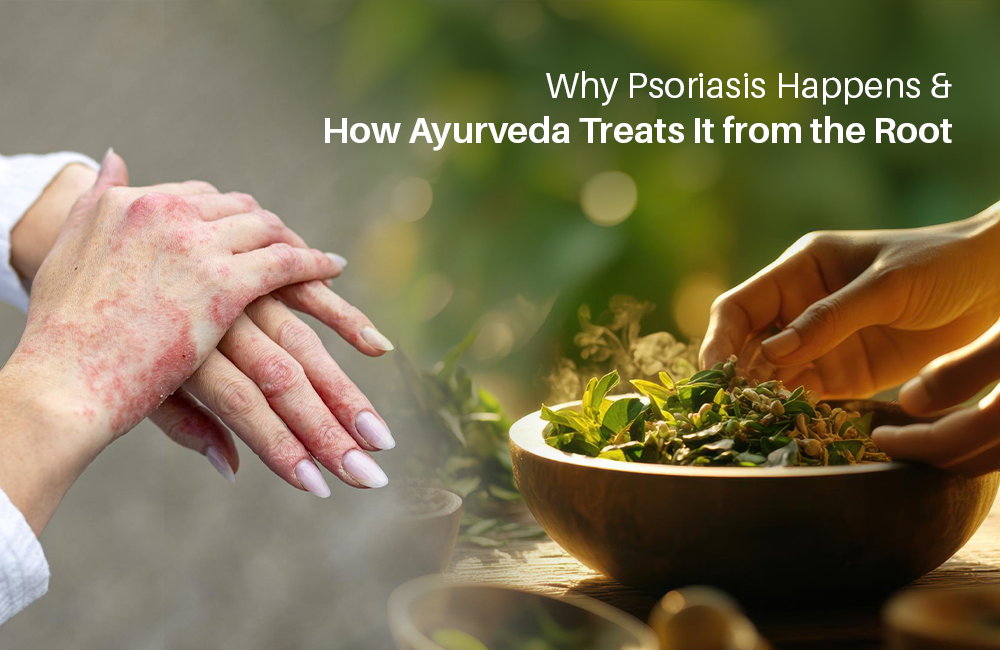
Psoriasis is a chronic, inflammatory autoimmune condition that causes the skin to form red itchy rashes, patches, and silver scales.
Psoriasis is often linked to people when they face stress, leads an unhealthy life with poor dietary choices and has genetic factors adding up to the chances of this condition affecting them. Modern medicine at best focuses on temporarily suppressing the symptoms with cream, phototherapy, biologics, or other topical steroids. They don’t address the root issue at all, which increases the chances of psoriasis flaring up more often.
Ayurveda classifies psoriasis as Kitibha or Eka Kushtha, a chronic skin disease. It majorly roots from poor digestion (Agni), imbalance of the Tridoshas, and the accumulation of Toxins (Ama). The best Ayurvedic Hospitals in Kerala offer Root cause psoriasis treatment to ensure maximum relief for the patient.
UNDERSTANDING PSORIASIS
Psoriasis is a chronic skin disease that causes a rash with itchy, scaly patches, and results in hyperproliferation of the skin. It’s most notably seen on the scalp, knees, elbows, and torso. It’s a non-contagious, but an auto-immune disorder which varies in chronicity.
Types of Psoriasis
- Plaque Psoriasis – The most common type of psoriasis which causes red, itchy patches with silvery scales to form on the skin. They are itchy and often painful, which explains chronic nature.
- Nail Psoriasis – This type of psoriasis affects the finger and toenails. They cause nail discoloration, nail pitting (hole on the nail surface), abnormal nail growth, and even lead to the nails loosening and separating from the nail bed.
- Guttate psoriasis – Shaped like a drop, they appear often after a flu, throat infection or upper respiratory infections and heal on their own. More commonly seen on kids and young adults.
- Inverse psoriasis – they are red patches with no scaling, mainly affecting the skin folds like the groin, armpits or below breasts, often triggered by fungal infections and worsened by friction or moisture.
- Pustular psoriasis – It’s a rare and serious variant that causes red skin covered with small pus-filled blisters to form up. They occur mostly inside your palm or under the soles of your foot but can affect your whole body.
- Erythrodermic psoriasis – It’s rare, but its severity makes it quite dangerous. The body becomes red, inflamed, and layered by peeling rashes, causing constant itching, fever, pain and dehydration, even leading to heart failure.
Common symptoms
- Red, raised patches of skin covered by silver scales. The rash colors could be black, brown, pink, or purple shades.
- Dry, cracked skin that causes itchiness and bleeding when scratched.
- Scalp flakes, thick patches.
- The nail is affected by discoloration, nail pitting, thickening, or lifting.
- Burning or soreness at the inflicted place.
- Occasional flare ups even during the remission phase.
- Small scaling spots.
Psoriasis From the Lens of Modern Science.
Modern science views Psoriasis as a skin disorder that has no eternal cure but can be suppressed temporarily.
- Autoimmune Imbalance – The biggest problem with Psoriasis is that it is an autoimmune disorder. The immune system mistakenly attacks healthy skin cells, forcing them to multiply unevenly. This results in the formation of thick plaques and scaly red patches.
- Genetic factors – The chance of contracting Psoriasis is influenced by your family’s history with the disease. The chances of inheriting the disease from your family cannot be overlooked.
- Stress & triggers – Lifestyle factors could cause emotional or physical stress whereas mental triggers like infections, alcohol, smoking and environmental factors also work as a reason for the disease to flare up.
- Gut health connection – Studies have found a connection between gut microbiome imbalances leading to psoriasis. The chances of your immunity malfunctioning and leading to systemic inflammation are closely tied with poor gut health.
Ayurvedic understanding of Psoriasis
- Tridosha Imbalance – the major doshas breaking out of their state of balance causes the body’s defenses to weaken. Ayurveda prioritizes the harmony and equilibrium of Kapha, Vita, and Pita by finding out those factors which affect the body’s Tridosha framework.
- Accumulation of Ama or Toxins – When the body has an unbalanced functioning of dosha, along with poor purgation, it leads to the collection of Ama. These toxins trigger inflammation in the skin, resulting in scaling, plaquing, and itching.
- Poor Agni or digestion – Ayurveda for Psoriasis explains how irregular Agni causes improper metabolism. Poor digestion leads to the body not absorbing nutrients and slowing down regeneration. That’s why Ayurvedic treatment enforces dietary changes with proper herbal medication.
- Impact of lifestyle & diet – Stress, sleeplessness and sedentary life disturb Vata and Pitta whereas incompatible food-style affects kapha and pitta, causing Ama to form up. Environmental triggers could also worsen flare-ups in your body.
Psoriasis is more than just a skin condition; it’s a skin disorder that shows the body’s imbalance. It involves impaired digestion (Agni), Ama formation in the bloodstream and lymph, and major tissues like Rasa, Mamsa, Rakta, which form into scales and thick plaques. The disease reflects tridoshic imbalance – Vata causing dryness and cracking, Kapha causing congestion and heaviness, and Pita causing inflammation and burning, worsened further by poor lifestyle and dietary choices.
That’s why choosing an Ayurvedic psoriasis hospital for a systematic treatment in harnessing detoxification techniques, herbal medication and lifestyle improvement is essential for treating the problem, rather than just suppressing the symptoms.
Ayurvedic Diagnosis of Psoriasis
The treatment begins with Pulse reading (Nadi Pariksha), to detect any signs of dosha imbalance by understanding the intensity or speed of the pulse.
Evaluating the changes on the skin helps in determining dosha involvement
- Red, itchy patches with a burning sensation and inflammation are signs of Pitta type psoriasis.
- Thick, silverish scales and plaques with high stiffness but less itching is a sign of Kapha type.
- Dry, rough, and cracked skin with severe scaling are signs of the Vata type.
Physicians also check the temperature, color, moisture, and texture of the skin to understand dosha imbalances better and to be better prepared for when the skin inflammation causes psoriasis to flare up.
Digestive health evaluation involves Agni assessment. Weaker Agni indicates Ama (toxin) accumulation, which later develops into skin disorders. Everything related to digestion, from appetite to bowel moments, symptoms like bloating, to food consumption styles are assessed, to map the flaws in dosha.
Lifestyle factors like daily routine, activities, mental state, sleep, and dietary patterns often trigger or worsen psoriasis.
Ayurvedic Root cause Psoriasis treatment
- PANCHAKARMA, the 5 central treatments of SHODHANA.
- Vamana helps in reducing scaling, removing mucus, plaques, and Ama stored in the upper body. It’s most beneficial for Kapha-dominant psoriasis.
- Virechana (purgation) deals with cleansing the liver, sk in, and blood. It deals with inflammation, redness, and burning sensations. Most ideal for Pitta type.
- Raktamokshana (Bloodletting) removes toxins in the blood. This helps in reducing rapid flare-ups, redness, and burning. It also assists in skin purification. Used in selected cases with strong Pitta and Rakta dushti.
- Takradhara (Medicated buttermilk pouring) focuses on calming the mind,improving sleep and cooling the body. It works well against stress-triggered psoriasis.
- Abhyanga & Swedana (Oil therapy and Steam) enhances body circulation and boosts tissue nourishment. It softens plaques, prepares the body for Panchakarma, and soothes Vata.
Panchakarma for skin diseases is one of the most natural and effective approaches that truly uplifts a person’s wellbeing and holistic health.
- Internal Herbal Medication
- Guduchi reduces inflammation and makes digestion better.
- Neem helps in purifying blood and treating skin issues like itches and rashes.
- Manjistha helps in effective blood cleansing, detoxification, and reducing inflammation.
- Khadirarishta helps in improving skin metabolism, mitigate itching, plaque formation and discoloration.
- External Applications
- Natural herbal oils helps in reducing rashes, scaling, itching while soothing the skin nourishing the skin tissues. Eg – Nalpamaradi oil, karanj oil are effective medicative herbal oils
- Medicated ghee like Mahatikta Ghrita supports detoxification with its anti-inflammatory and cooling properties.
- Special lepam or herbal pastes are also applied on the scales and rashes for promoting skin regeneration and healing.
- Diet & Lifestyle Correction
- Anti-inflammatory diets are encouraged to treat psoriasis. Warm, cooked meals, preferably greens, that are easy to digest and not heavy on the body. Avoid oily and heavy foods that could
- Avoid foods that don’t go well with each other, like milk + fish, milk + salty foods, oily foods + cold drinks.
- Stress reduction practices must be enforced into your daily life to lead a holistic life. Meditation, adequate sleep, yoga, pranayama and oil massages are the best solutions to keep stress under control.
Benefits of Ayurvedic Psoriasis Treatment
- Long-term relief – Ayurveda focuses on making the body holistically better by balancing doshas, dietary lifestyle and ensuring proper application of anti-inflammatory and bacterial herbs; this will allow the body to get longer remissions and a long-term relief.
- Reduces flare-ups – Internal triggers causes inflammation, which leads to flare-ups. Ayurveda keeps it in check by stabilizing digestion, doshas, stress and suppressing any factors that would affect the skin’s immunity.
- Improves gut health – Ayurveda has already proved that Gut heath affects skin conditions. Any imbalances in the gut would cause skin inflammation. Ayurveda ensures proper dietary solutions, herbal medications, and guidance in maintaining proper gut health.
- Root cause psoriasis treatment – Ayurveda always addresses the root problem directly by initiating a treatment for the body from within. By improving the internal functions, the body balances the Doshas and helps in extending remissions.
- Enhances skin immunity – Ayurveda uses the application of anti-inflammatory, anti-bacterial and immunity boosting medicinal herbs to nourish the internal functioning of the body; this in turn revitalizes skin immunity.
How Long Does It Take to Recover?
The disease has varying levels of chronicity that decides the duration of the recovery treatment.
- Acute Level – 1.5 to 3 months of treatment.
- Sub-chronic – 3 to 6 months
- Chronic – 6 to 12 months
- Very chronic – 9 to 18 months with mandatory maintenance therapy even after remission.
Dosha imbalance (Vikriti) level – Kapha, pitta and vitta are the major doshas in our body that affect a person’s physiological, mental and emotional health. The number of affected doshas influences the recovery process of the body –
- Vata dominant psoriasis causes the most dryness, cracking, and scaling. The recovery lasts somewhere between 2-4 months.
- Kapha Dominant psoriasis causes excessive scaling and thick plaques. They are often the slowest to respond to treatments, with over 4-8 months of recovery time. The major reason behind it is the dense nature of kapha, which makes it hard to shift. Oil treatments work effectively here.
- Pitta dominant psoriasis demands blood purification and cooling, as there are signs of inflammation, redness and burning. The expected duration of recovery is 3-6 months.
- Tridoshic Psoriasis is the most dangerous, as all three doshas are equally affected, demanding over 6-12+ months of recovery.
Maintaining proper discipline is the key to achieving the best recovery. A disciplined lifestyle without breaking off from the treatment itself is an effective way to treat chronic skin disorders.
CONCLUSION
Ayurveda treats all diseases holistically; Psoriasis is no different. Psoriasis is a frustrating disease that affects your daily life. Ayurveda for Psoriasis utilizes the best of self-healing, herbal medication, therapeutic treatment and the root-cause approach to gain the most effect.
How we take care of our body internally affects how the body presents itself on the outside. Proper and disciplined nurturing replenishes the body’s operations and brings an overall balance, which ensures clear and healthy skin.
Psoriasis is a disease that needs to be treated diligently. There must not be any sign of negligence or poor lifestyle choices. That’s where Omshree, one of the best ayurvedic hospitals for psoriasis, showcases its excellence. We provide therapeutically soothing ayurvedic treatments that specialize in chronic skin disorders and other skin inflammation causes.